This section provides a subset of Starfleet’s astrometrics database as it applies to the tIhoS pagh’lan Mission. Please note that some information may be redacted, depending on your security clearance.
The Known Galaxy
Z Axis View
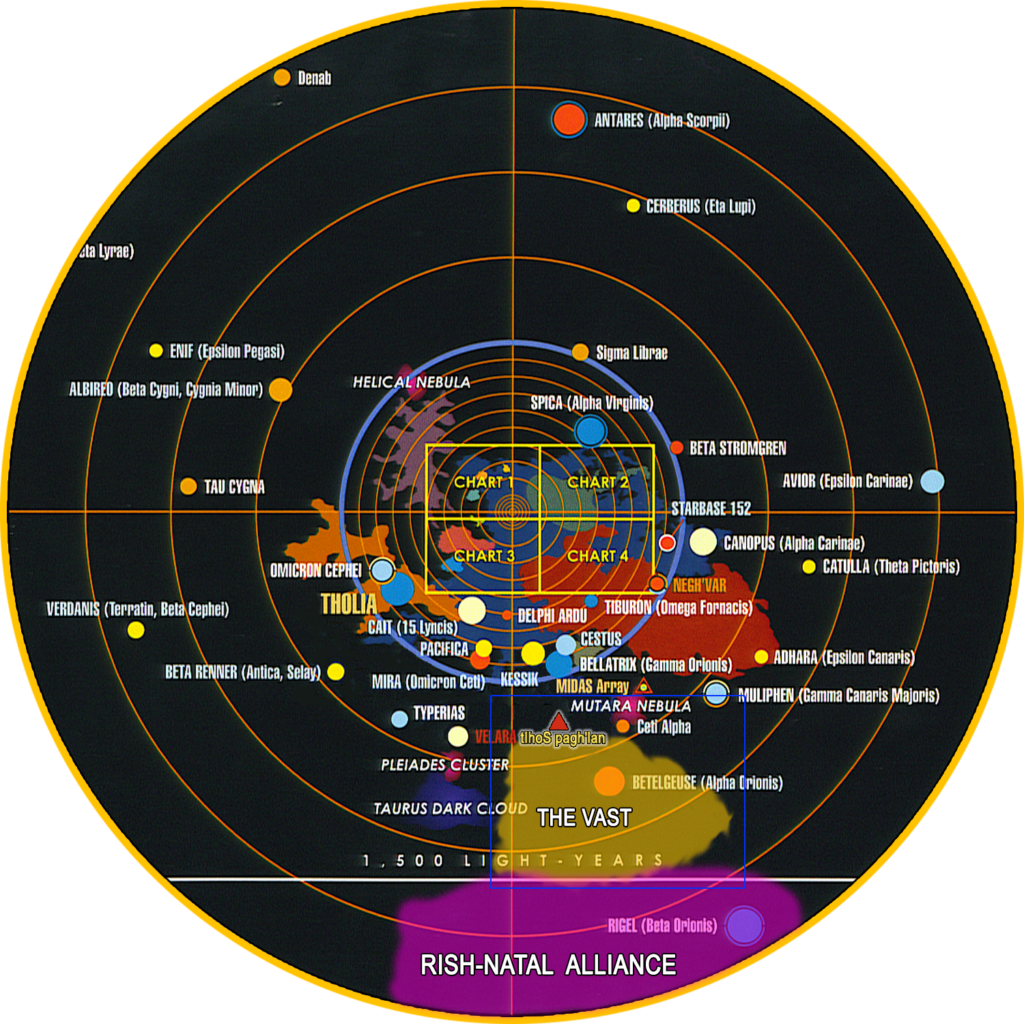
Kazar Sector
Also known as Sector 23, the Kazar Sector is home to the Kazarite civilization. Starbase 30, the overall command for the southern and rimward-facing aspects of Starfleet Command, orbits the Kazar homeworld.
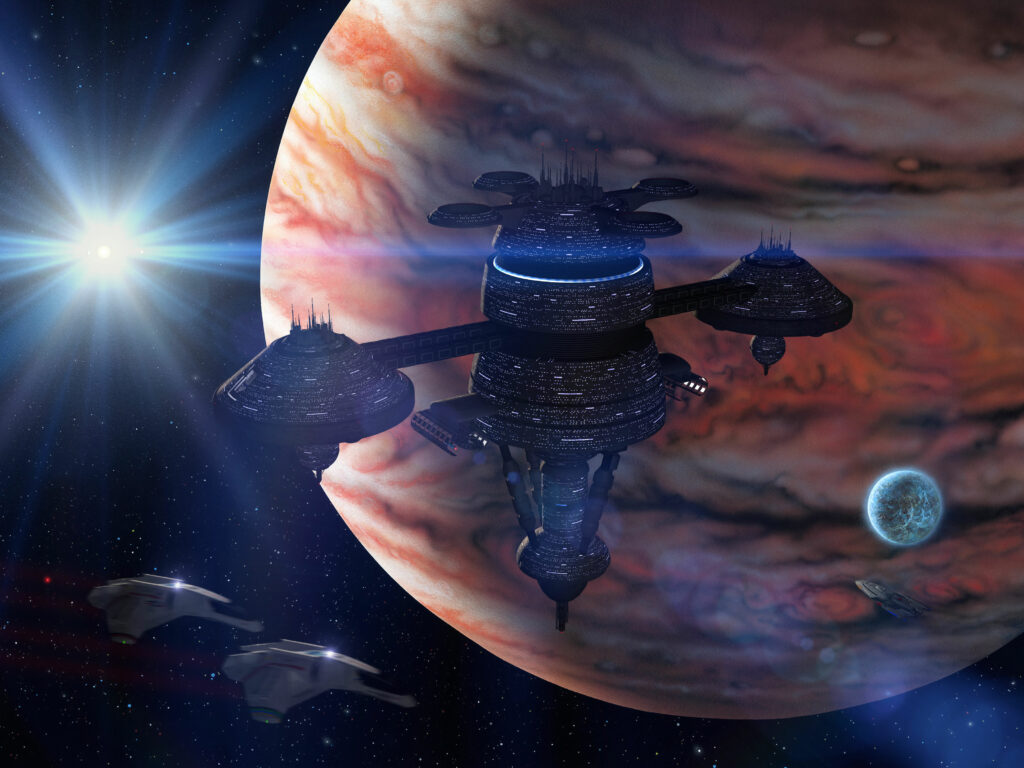
Starbase 30
Starbase 30
Starbase 30 is currently under the command of Rear Admiral William Lawrence Clarke, and is the coordination point for all the Federation’s interests in the southern and rimward-focused area of the galaxy. Unlike similar stations in other quadrants, there is no dedicated fleet assigned to Starbase 30. The outer rim is simply too poorly populated to make such a stationing feasible.
Starbase 30 is also the Federation’s last communications array facing the southern and rimward edges of the galaxy.
Beta Quadrant (Z-Axis)
The Vast
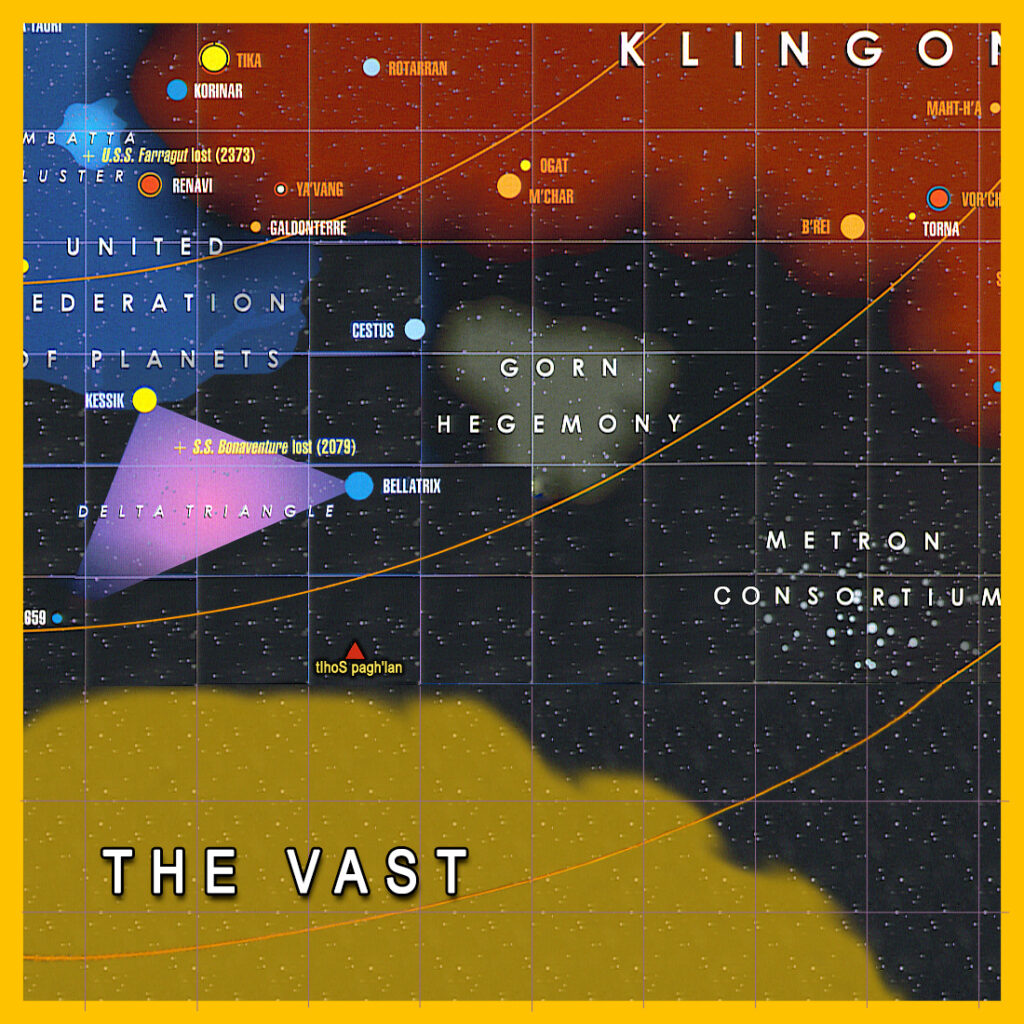
The Klingons call it “pagh’lan” (“nowhere”). The Gorn call it “Sethgruss” (“unseen pit”). Starfleet calls it “The Vast.“
Whatever you call it, it’s odd.
The Rish-Natal Combine
Heading rimward on the other side of the Vast exists the Rish-Natal Combine, a mysterious government who is technologically ahead of the Federation, and whose members have never been seen.
tIhoS pagh’lan System
The tIhoS pagh’lan (Klingon: “Almost Nowhere”) system has four planets surrounding a G-type star, similar to Sol. At the very edge of the sector is a massive asteroid belt, which is believed to be the remains of tIhoS pagh’lan V, a large planet composed of many valuable elements. At the edge of the system is tIhoS pagh’lan Station, a multi-government installation governed under the Vast Pact of 2298 and built in the hulk of a Rish-Natal outpost.
tIhoS pagh’lan Station usually orbits about 100,000 kilometers from the asteroid belt.
The entire system is approximately 1.2 light years from the nearest edge of the Vast, though that figure varies as the Vast’s borders move. The range of shift is usually is less than .1 of a light year, though shifts as high as .3 have been observed.
tIhoS pagh’lan System (Z Axis)
Planets of tIhoS pagh’lan
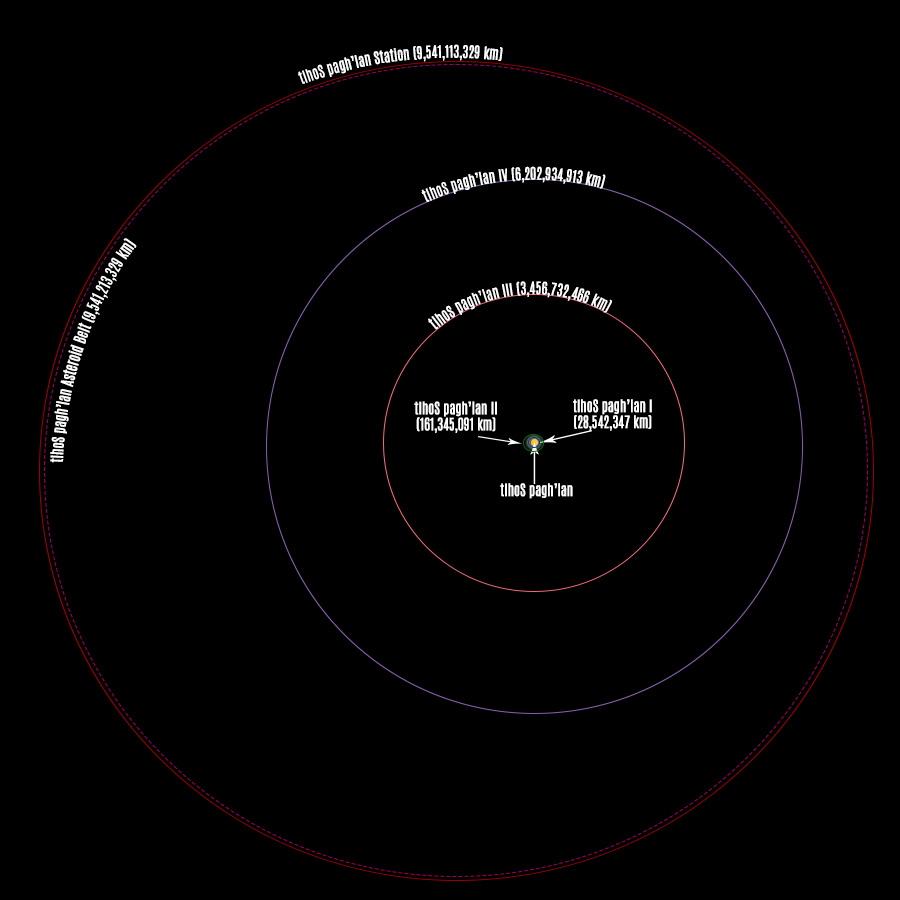
tIhoS pagh’lan has four planets.
tIhoS pagh’lan I
- Class: Y
- Distance: 28,542,342 km
- Radius: 8,782,962 km
- Gravity: 7.44 G
- Orbit: 4.3 days
- Rotation: 6 hours
- Mean Temperature: 139 C
- Atmosphere: 0.25 atm (CO2 89.61%)
- Water/Ice Index: 1
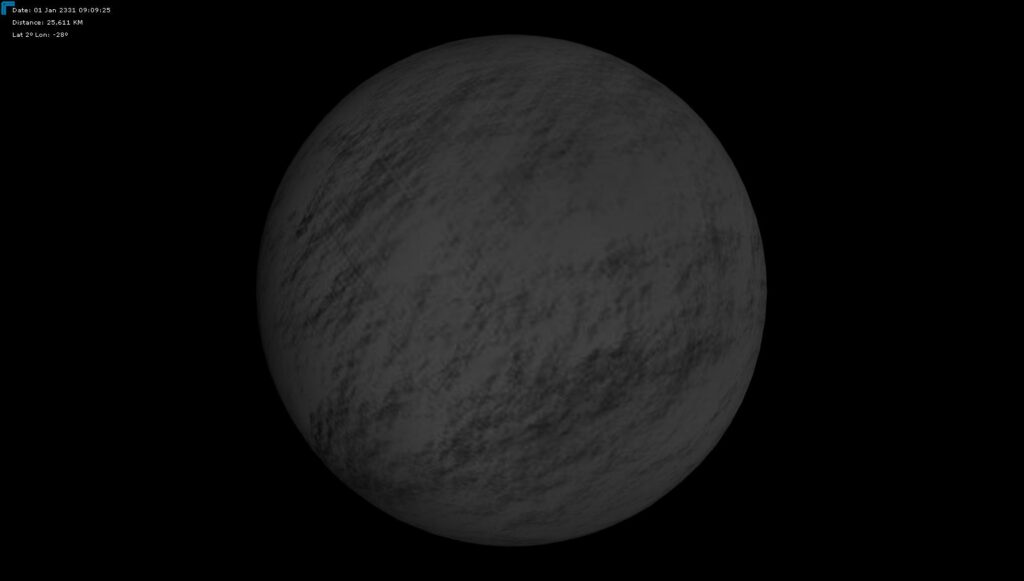
tiHoS pagh’lan I is a small, rocky planet, with a corrosive atmosphere and constant magma flows. A so-called “demon planet,” it is entirely uninhabitable by organic life. It has large quantities of sulfur, nickel, magnesium, and silicon. The solar winds deposit helium and hydrogen on the planet in significant quantities.
It has no satellites.
tIhoS pagh’lan II
- Class: M
- Distance: 161,345,091 km
- Radius: 7,940.2 km
- Gravity: 1.06 G
- Orbit: 57.75 days
- Rotation: 24 hours
- Mean Temperature: 18 C
- Atmosphere: 0.85 atm (N2 75.2%, 02 22.73%, Ar 0.72%, C02 0.2%)
- Water/Ice Index: 56.95
- Species Type: Proto-Vulcanoid
- Population: 12,330
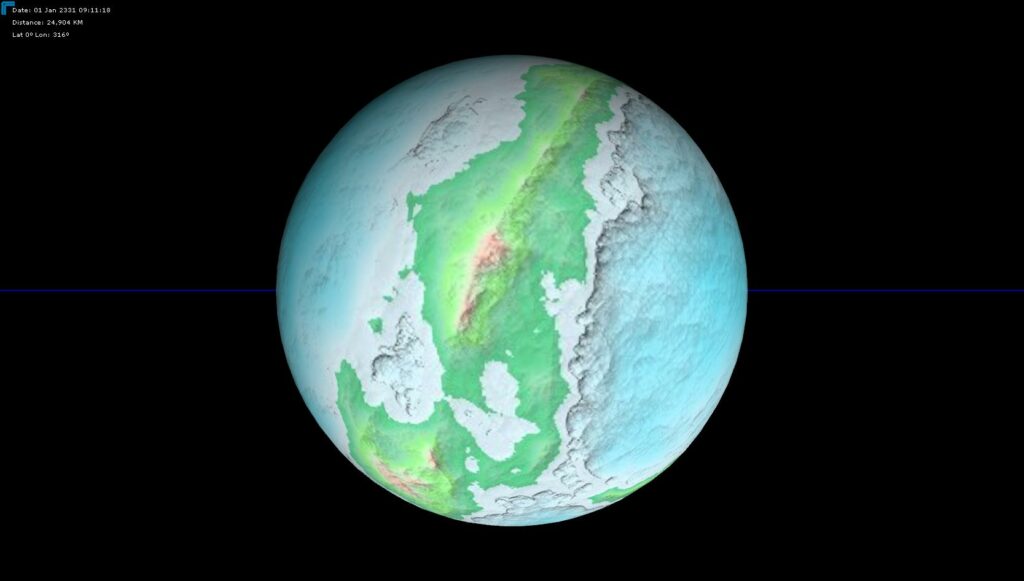
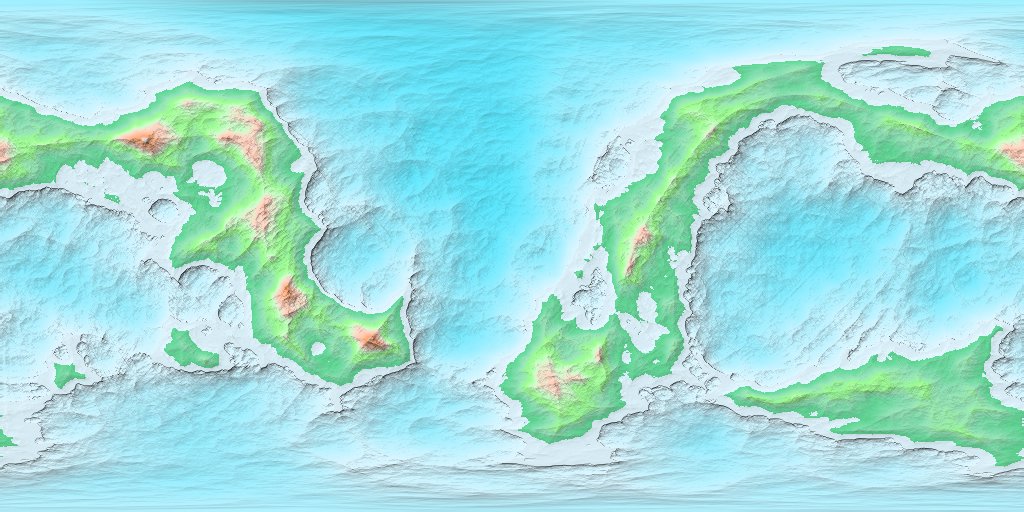
tIhoS pagh’lan II is a Class M world, dominated by a large mega-continent and also possessing a small continent and several large islands. A placid, tropical world with plentiful natural resources, it is home to a proto-Vulcanoid species, currently in a stage similar to Earth’s middle Paleolithic period.
In the Vast Pact of 2298, the Federation, Gorn, and Klingons agreed to take a hands-off approach with this world.
tIhoS pagh’lan II has a single satellite, tIhoS pagh’lan IIa.
tIhoS pagh’lan IIa
- Class: D
- Distance: 520,023 km
- Radius: 2,023.2 km
- Gravity: 0.37 G
- Orbit: 34.29 days
- Rotation: 0 hours
- Mean Temperature: -273 C
- Atmosphere: 0.25 atm (C02 64.78%, N2 31.9%, Ar 1.99%, 02 0.23%)
- Water/Ice Index: 19
This rocky moon is uninhabited, but large for a satellite. It appears slightly smaller from the surface of its world than Luna does from Terra.
tIhoS Pagh’lan III
- Class: S
- Distance: 3,456,732,466 km
- Radius: 52,292.4 km
- Gravity: 2.3 G
- Orbit: 15.69 years
- Rotation: 144 hours
- Mean Temperature: 178 C
- Atmosphere: None
- Water/Ice Index: n/a
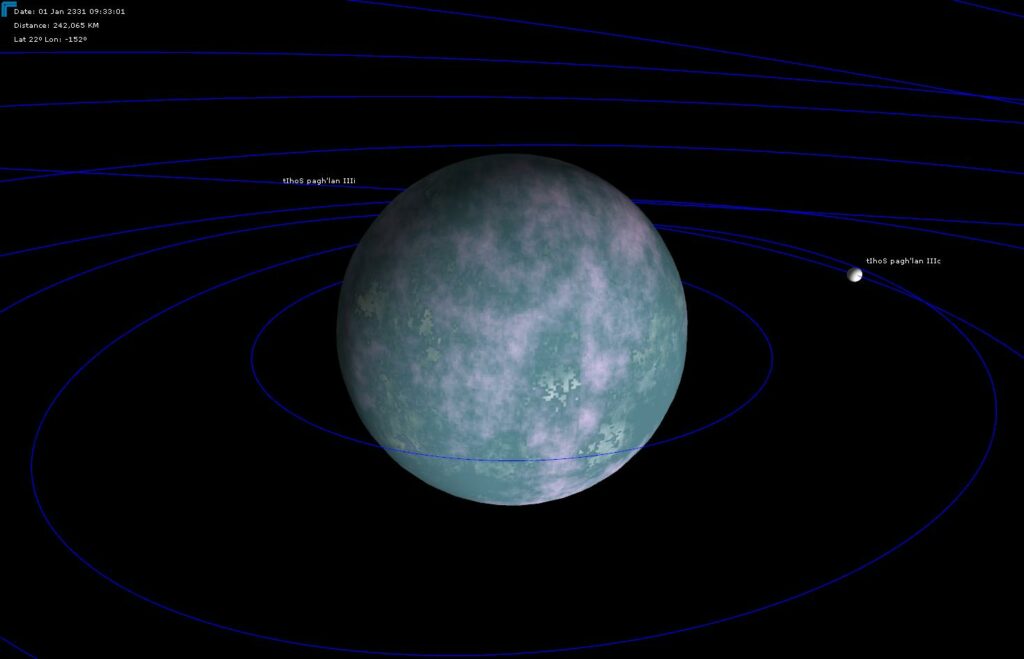
tIhoS pagh’lan II is a gas giant with a significant number of satellites. Its 10 moons are all uninhabitable rocks, but several are large enough and possess enough water for terraforming. However, their significant distance from their star renders this usage highly unlikely.
As per the Vast Pact of 2298, none of the moons may be mined, though illegal mining operations have occurred in the past.
tIhoS pagh’lan IV
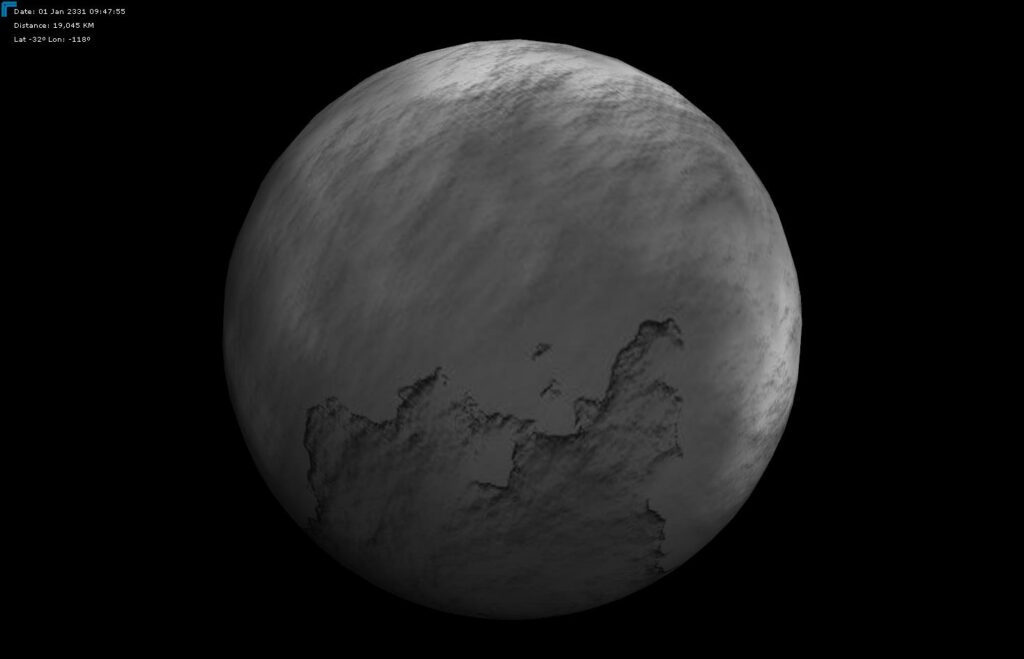
- Class: C
- Distance: 6,202,934,913 km
- Radius: 6531.2 km
- Gravity: 1.08 G
- Orbit: 37.71 years
- Rotation: 72 hours
- Mean Temperature: -228 C
- Atmosphere: 0.44 atm (CO2 82.9%, N2 12.15%, Ar 3.24%, O2 0.41%)
- Water/Ice Index: 31
An icy, rocky world, tIhoS pagh’lan IV is the sort of world that would be mined elsewhere in the galaxy. Once again, due to the Vast Pact of 2298, the world is off-limits to legal mining.
It has no satellites.
tIhoS pagh’lan Asteroid Belt
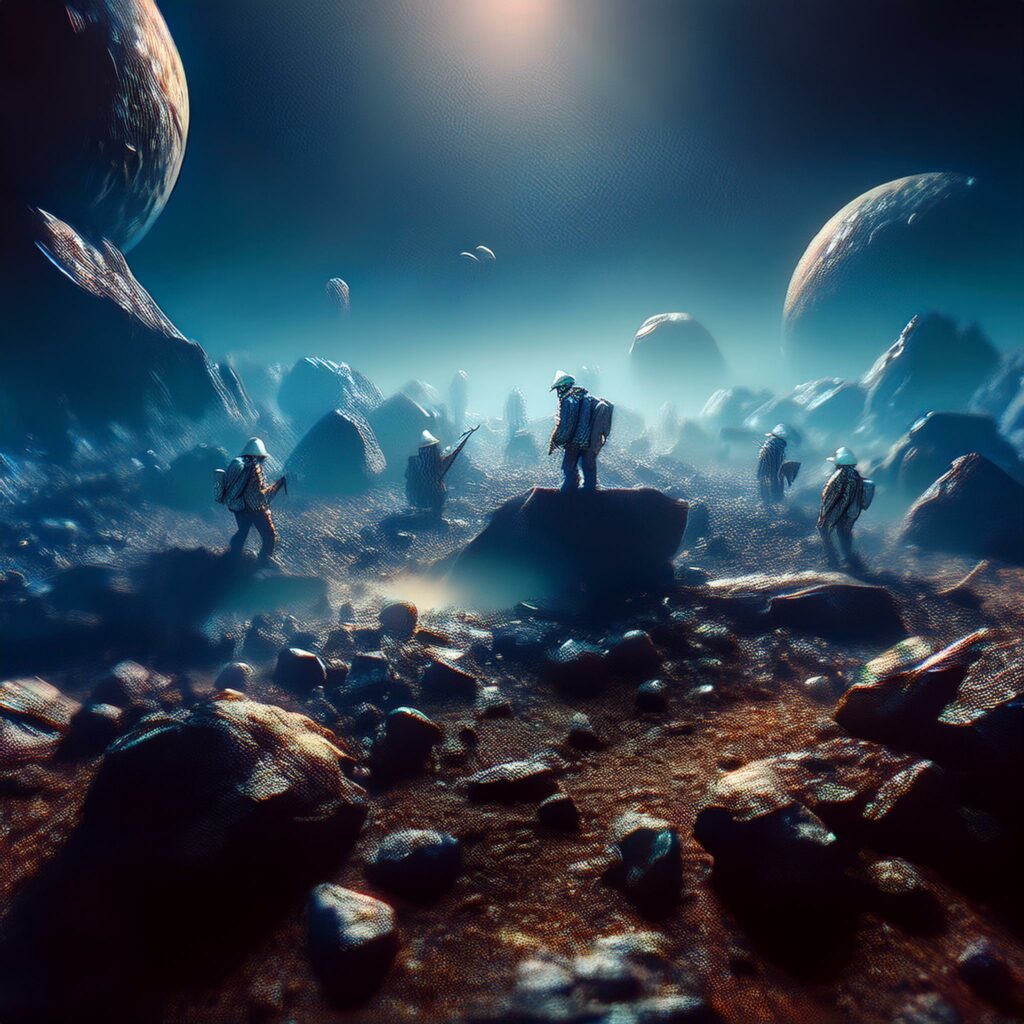
The remains of an exploded megaplanet, this asteroid belt was once a treasure trove of rare elements, primarily dilithium, kelbonite, helium, hydrogen, tritanium, duridium, iron, and cormaline. Many other elements could be found in smaller quantities.
The large amount of kelbonite in the fields frustrates both sensors and transporters, making mining dangerous work. Most of the asteroid field has been played out, but rich veins are still discovered on an infrequent basis.
The belt is approximately 500 million kilometers long, and about 750,000 kilometers in thickness. It orbits the local star at a range of 9.54 billion kilometers.
tIhoS pagh’lan Station
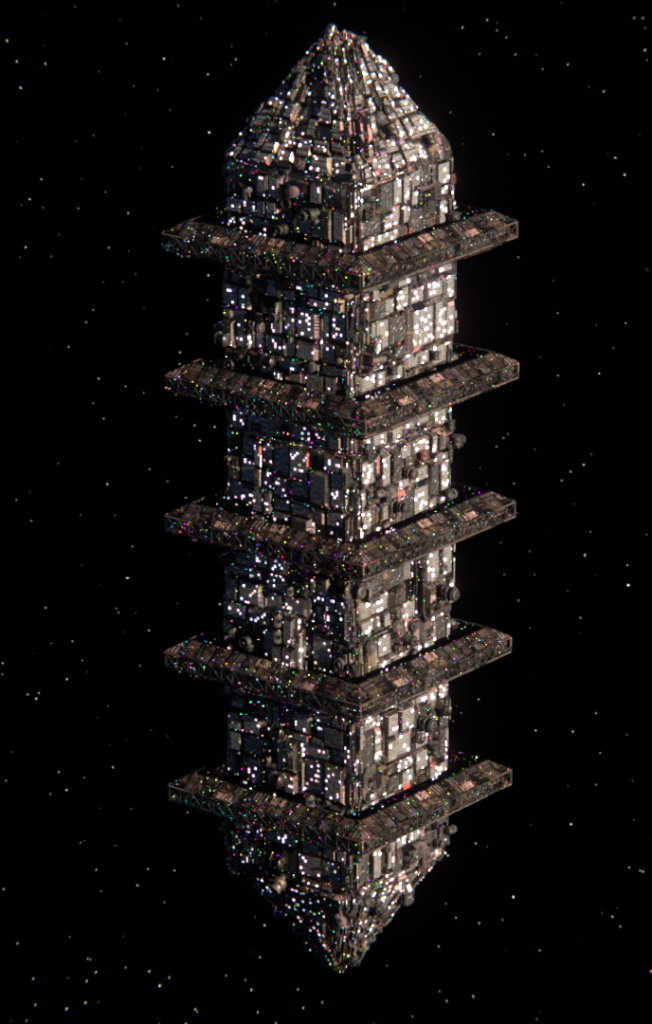
tIhoS pagh’lan Station is a composite effort by the Federation and the Klingon Empire, built into the extraordinarily durable spaceframe left behind by the Rish-Natal. It is home to the tIhoS pagh’lan Mission, a joint Klingon/Federation/Gorn operation.